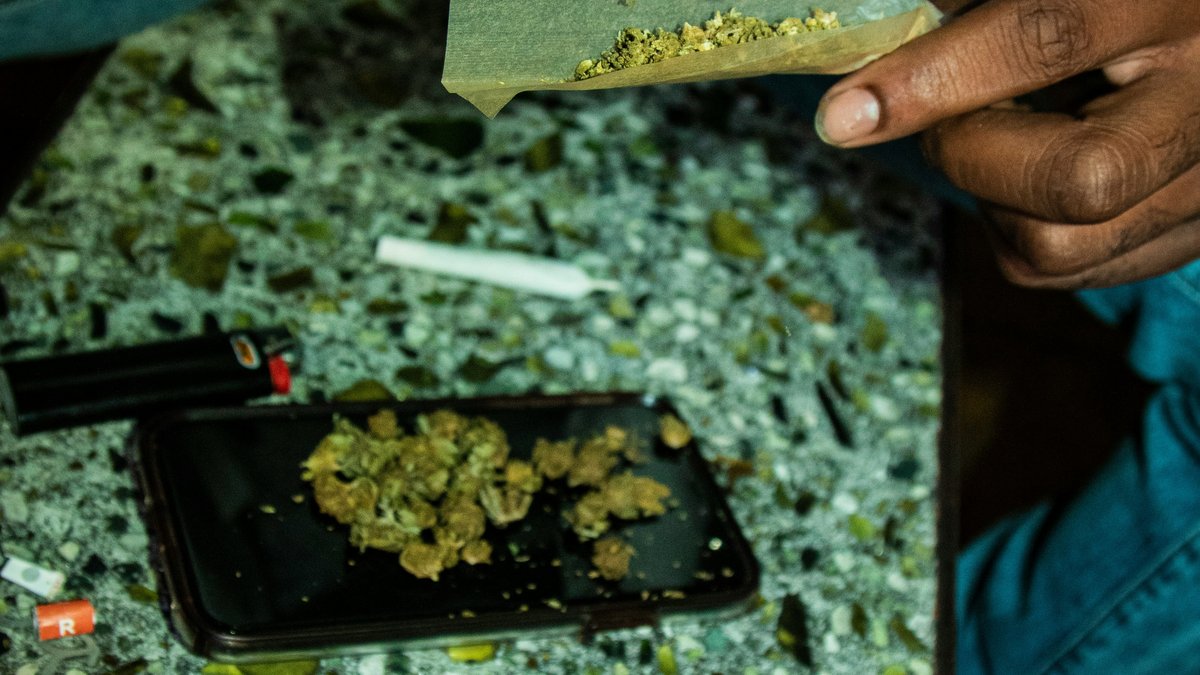
A deeply unnecessary investigation into the human brain, the marijuana plant, and the mysterious disappearance of an entire Saturday afternoon.
By Our Special Correspondent, Somewhere on the Couch
There are approximately eight billion people on Earth, and a surprisingly large number of them have, at one time or another, looked at an ordinary Tuesday and decided it could use a little improvement.
Enter cannabis.
For thousands of years, humanity has cultivated this remarkable plant, apparently discovering that there are several ways to contemplate the universe, and that one of them involves staring at a refrigerator for eleven minutes.
The ancient Chinese used it. The Indians incorporated it into religious and medicinal traditions. The Greeks wrote about it. And somewhere along the way, an entire generation of Americans discovered that music sounded better, potato chips tasted better, and the prospect of doing absolutely nothing could become a surprisingly ambitious undertaking.
But something curious has happened.
Despite decades of prohibition, millions of dollars spent on anti-marijuana campaigns, and enough public-service announcements to make an entire generation suspicious of eggs, cannabis has refused to disappear.
In fact, it has become an industry.
And therein lies the mystery.
The Brain: Nature's Original Head Shop
The human brain is an extraordinary piece of biological engineering. It regulates breathing, memory, appetite, movement, emotion, and the ability to remember why you walked into the kitchen.
It also contains something called the endocannabinoid system.
This system, discovered by modern researchers, helps regulate a variety of bodily functions, including appetite, mood, pain perception, and memory.
It turns out the human body manufactures its own cannabinoid-like chemicals.
That's right. You don't even have to grow anything.
Your brain has apparently been running a small cannabis laboratory all along.
The discovery of cannabinoid receptors in the brain helped explain how THC, the principal intoxicating compound in marijuana, produces its effects.
THC interacts with CB1 receptors, particularly abundant in areas involved in memory, coordination, reward, and perception.
Which explains a few things.
For example, why somebody can be halfway through telling a story, forget the beginning, and nevertheless find the conclusion enormously satisfying.
The Great Experiment: What Happens When Everybody Gets High?
For much of the twentieth century, American marijuana policy was based less on nuanced scientific investigation than on the assumption that smoking a plant represented a threat to civilization.
There were hearings, arrests, propaganda films, and dire predictions about the imminent collapse of Western society.
Then came the 1960s.
Suddenly, a generation of young Americans discovered jazz, rock and roll, Eastern philosophy, political protest, and the extraordinary possibility that perhaps the government didn't know everything.
Cheech and Chong eventually gave this cultural phenomenon a soundtrack.
Their comedy worked because it recognized something fundamental: the stoner wasn't necessarily a revolutionary, a criminal, or a philosopher.
Sometimes he was just a guy who couldn't find his car keys.
And yet, beneath the comedy, there was a serious cultural question: Why did so many people want to alter their consciousness?
The answer, it turns out, isn't particularly simple.
Some people seek relaxation. Others enjoy the altered sensory experience. Some use cannabis in an effort to manage symptoms such as chronic pain or nausea. Others simply enjoy the ritual and social experience.
And some people apparently believe that an evening spent discussing whether a hot dog is technically a sandwich constitutes intellectual progress.
The Munchies: A Scientific Achievement of Questionable Nutritional Value
One of the most recognizable effects of cannabis is increased appetite.
Researchers have investigated how THC influences appetite-regulating pathways, including interactions involving the hypothalamus and reward systems.
The experience is familiar to anyone who has ever discovered that a previously uninteresting bag of cheese-flavored snacks has suddenly become the most important culinary achievement since the invention of fire.
But the munchies are not merely a joke.
Cannabinoid signaling affects appetite, smell, taste, and reward processing. These mechanisms have attracted legitimate medical interest, particularly in patients experiencing appetite loss.
Unfortunately, the research has yet to establish whether THC can make broccoli taste like pizza.
This remains an important unanswered question.
The Problem With Thinking You're Smarter Than You Are
Here is where things become interesting.
Cannabis can temporarily affect memory, attention, reaction time, coordination, and judgment.
The person experiencing these effects may nevertheless feel unusually insightful.
This creates an intriguing philosophical problem.
If you believe you've just solved the mysteries of human existence, but cannot remember where you put your telephone, how much confidence should we place in your conclusions?
The answer, scientifically speaking, is probably not enough to warrant publishing your findings.
THC affects the brain's information-processing systems. Its effects vary considerably with dose, potency, individual biology, and frequency of use.
And although many adults use cannabis without developing serious problems, cannabis use disorder is a genuine condition. Frequent use, particularly of high-potency products, increases the risk of dependence and other adverse effects.
There are also legitimate concerns about cannabis use during adolescence, pregnancy, and in people vulnerable to psychosis.
In other words, the plant may be natural, but that doesn't make every possible use harmless.
Poison ivy is natural, too. Nobody is organizing a festival around that.
The Legalization Experiment
As states began legalizing cannabis for medical and recreational purposes, America embarked on an enormous social experiment.
The results have been complicated.
Legal markets have generated substantial commercial activity, employment, and tax revenue. They have also raised questions about advertising, potency, youth access, impaired driving, and public health.
The old argument that marijuana was either completely harmless or an existential threat to civilization has proved inadequate.
Reality, inconveniently, has declined to cooperate with either political position.
The modern challenge is to develop sensible regulations, support credible scientific research, discourage dangerous consumption, and distinguish occasional adult use from patterns of dependence.
That may not be as entertaining as a Cheech and Chong movie, but somebody has to do it.
So Why Do We Keep Coming Back?
Perhaps the most interesting thing about cannabis isn't the plant itself.
It's the human desire to change how we experience the world.
We drink coffee to become more alert. We drink alcohol to become less inhibited. We listen to music to change our moods. We exercise to alter our chemistry. We meditate to quiet our thoughts.
And sometimes, people smoke marijuana because they want to experience an ordinary evening differently.
There is nothing particularly mysterious about the desire.
The mystery is how a species capable of building particle accelerators, mapping the human genome, and sending robots to Mars can still spend forty-five minutes trying to decide what to order for dinner.
Maybe that's the real lesson.
Human consciousness is an extraordinary thing. It is also occasionally ridiculous.
And perhaps the wisest approach is to enjoy the occasional absurdity without confusing it with enlightenment.
After all, the universe is almost fourteen billion years old.
You don't have to figure it all out tonight.
Especially if you've forgotten what you were talking about.
End of investigation.
The authors would like to thank the refrigerator, the makers of tortilla chips, and the person who invented the couch.
😂 The trick is that the humor works best when the underlying article is actually intelligent. Cheech and Chong provide the entertainment; the science provides the punchline.
Overview
- Cannabis has been used by ancient civilizations, including the Chinese and Indians.
- Modern research identified the endocannabinoid system within the human body.
- THC interacts with CB1 receptors, affecting memory, reward, and perception.
- Early American policy treated marijuana use as an existential threat to society.
- Cannabis consumption can cause appetite increase, known as the "munchies."
Facts Only
Humanity has cultivated cannabis for thousands of years, utilizing it in ancient Chinese and Indian traditions.
The human brain contains the endocannabinoid system, which regulates functions such as mood and appetite.
THC interacts with CB1 receptors located in brain areas related to memory and perception.
Twentieth-century American marijuana policy was based on assumptions of civilizational threat.
Cannabis use has led to the observed effect of increased appetite, or "the munchies."
THC can temporarily affect memory, attention, reaction time, coordination, and judgment.
Legalization of cannabis has generated substantial commercial activity and tax revenue.
Cannabis use disorder is recognized as a genuine condition, especially with high-potency products.
The article notes that cannabis use poses legitimate concerns during adolescence and pregnancy.
Executive Summary
Full Take
This piece functions primarily as sophisticated, humorous commentary masquerading as investigative journalism, ultimately serving as an expansive cultural examination rather than a purely scientific briefing. The narrative structure is built by juxtaposing profound scientific topics—like the brain's native chemistry—against mundane human realities, such as staring at a refrigerator or debating hot dog classification. This serves to gently critique the human tendency toward self-seriousness, while simultaneously validating the deep human desire for novel experiential states.
The underlying pattern engages in a form of Appeal to Nature (ARC-0012) when contrasting the plant's "natural" existence with regulatory efforts, yet this is immediately countered by the acknowledgement of inherent dangers (use during pregnancy, psychosis vulnerability), preventing a simple, uncritical endorsement of "nature's way." Furthermore, the rhetorical question regarding perceived insight ("If you believe you've just solved the mysteries of human existence, but cannot remember where you put your telephone...") operates as a self-correcting mechanism, preventing the argument from becoming an unearned endorsement of euphoria, which is a subtle check against the tendency toward ARC-0039 (Argument from Ignorance) regarding consciousness.
The core implication for agency is that while biological tools (like cannabinoids) offer pathways to altered states, the perceived value of those states must be weighed against demonstrable cognitive limitations. The text suggests that the true human narrative is not the drug's effect, but the species' persistent, and sometimes ridiculous, drive to question its own experienced reality. What other external pressures—economic, social, or environmental—compel individuals to seek these chemical deviations in experience? If consciousness is inherently dualistic, oscillating between extraordinary insight and mundane forgetfulness, how should society structure policies that address both poles? What non-pharmacological avenues do we overlook in this search for conscious novelty?
Patterns detected: none
Sentinel unavailable
The automated check of the source article's wording did not complete, so no result is shown.
This looks only at the wording of the original source article, not at this page's AI-written sections. A small local AI model made this estimate. It has not been checked against known human and machine texts, so treat it as provisional. It cannot show who wrote an article.
Sponsored-content signals
Patterns that vendor press releases and paid placements tend to share, counted in the source text. They are evidence to weigh, not a finding that this story is sponsored: trade news quotes executives too. How these are counted.
No attributed quotes we could class. 1 more could not be classed.
No subscription, as-a-service or "no upfront cost" phrasing.
No figure from an outside data source is followed by a product offered as the answer.
Not compared yet: we had 10 earlier stories from this publication and compare from 20.